| Event | Guy Fawkes Heritage Horse Association Open Day 2026 |
|---|---|
| Date | Sunday 11 October 2026 |
| Location | GFHHA Holding Facility, 1378 Guyra Rd, Wongwibinda, NSW (near Ebor, New England Tablelands) |
| Hosted By | The Guy Fawkes Heritage Horse Association Inc |
| Event Type | Open day, heritage horse viewing, horses for sale, community fundraiser |
| Includes | Meet the horses (including those for sale), meet the committee, merchandise and lunch available |
| Best For | Brumby and heritage horse lovers, families, anyone considering buying a Guy Fawkes Heritage Horse |
| Membership | Associate Membership available for $10/year |
| Official Website | guyfawkesheritagehorse.com |
| Facebook Page | The Guy Fawkes Heritage Horse Association |
The Guy Fawkes Heritage Horse Association's 2026 Open Day, running Sunday 11 October at their holding facility near Ebor in the New England Tablelands, is a rare chance to meet Australia's only wild horse population with proven military heritage, and to see firsthand the volunteer-run work keeping these horses alive after one of the darkest chapters in Australian wild horse history.
If you've never heard of the Guy Fawkes Heritage Horse, this is a story worth knowing before you go. These horses aren't just brumbies, they're the direct descendants of the Waler, the horse that carried Australia's Light Horse Brigade to victory at Beersheba in 1917, and today they're cared for entirely by volunteers working to make sure their history is never repeated. If you want stories like this landing in your inbox, join The Bush Pony Post and we'll keep you posted on events like this one.

What Is the Guy Fawkes Heritage Horse Open Day?
The Open Day is the Guy Fawkes Heritage Horse Association's main public event, held at their holding facility near Ebor, where visitors can meet the horses in person, including horses currently for sale, and hear directly from the volunteers and committee members who run the Association. It's also the Association's key annual fundraiser, with proceeds going toward feed, wormers, equipment and trucking for the horses in their care.
The 2026 Open Day is set for Sunday 11 October, though the full program hadn't been finalised at time of writing. Past Open Days have included horsemanship demonstrations, market stalls, camp oven cooking, and even live music in the evening, so it's worth checking the Association's Open Days page closer to the date for confirmed 2026 activities.
The History Behind the Guy Fawkes Heritage Horse
This part of the story matters, because it's the reason the Association exists at all. In October 2000, over 600 wild horses in the Guy Fawkes River National Park were killed in an aerial cull, carried out by helicopter as a rapid population control measure. Media coverage of the cull reached around the world, and public pressure led the Australian Government to commission a formal study into the horses' heritage value.
In February 2002, the Heritage Working Party's final report found that these horses carry genuine historical, military and cultural significance. They are direct descendants of the Waler, the horse type used by Australia's wartime cavalry, bought from stations across the old colony of New South Wales (which at the time included what's now Victoria and Queensland) and shipped to serve in conflicts including the Boer War and the First World War, among them the legendary cavalry charge at Beersheba in 1917. They're the only wild horse population in Australia with this proven heritage status.
Off the back of that finding, the Guy Fawkes Heritage Horse Association was formed in 2004 (initially known as the Guy Fawkes Wild Horse Management Association), with a clear purpose: take possession of horses passively removed from the park under NSW National Parks and Wildlife Service's ongoing trapping program, rehome them to the public, and work to ensure aerial culling is never used again in this park.
It's also worth knowing that the park itself wasn't always a national park. The main section of Guy Fawkes River National Park was only gazetted in 1972, at which point the graziers who'd worked the land were required to move off it. Most took their cattle and horses with them, but given the size and ruggedness of the terrain, and no fencing to speak of, some horses were left behind. Without local management from that point on, those horses' numbers grew steadily over the following decades, eventually leading to the population crisis that triggered the 2000 cull.
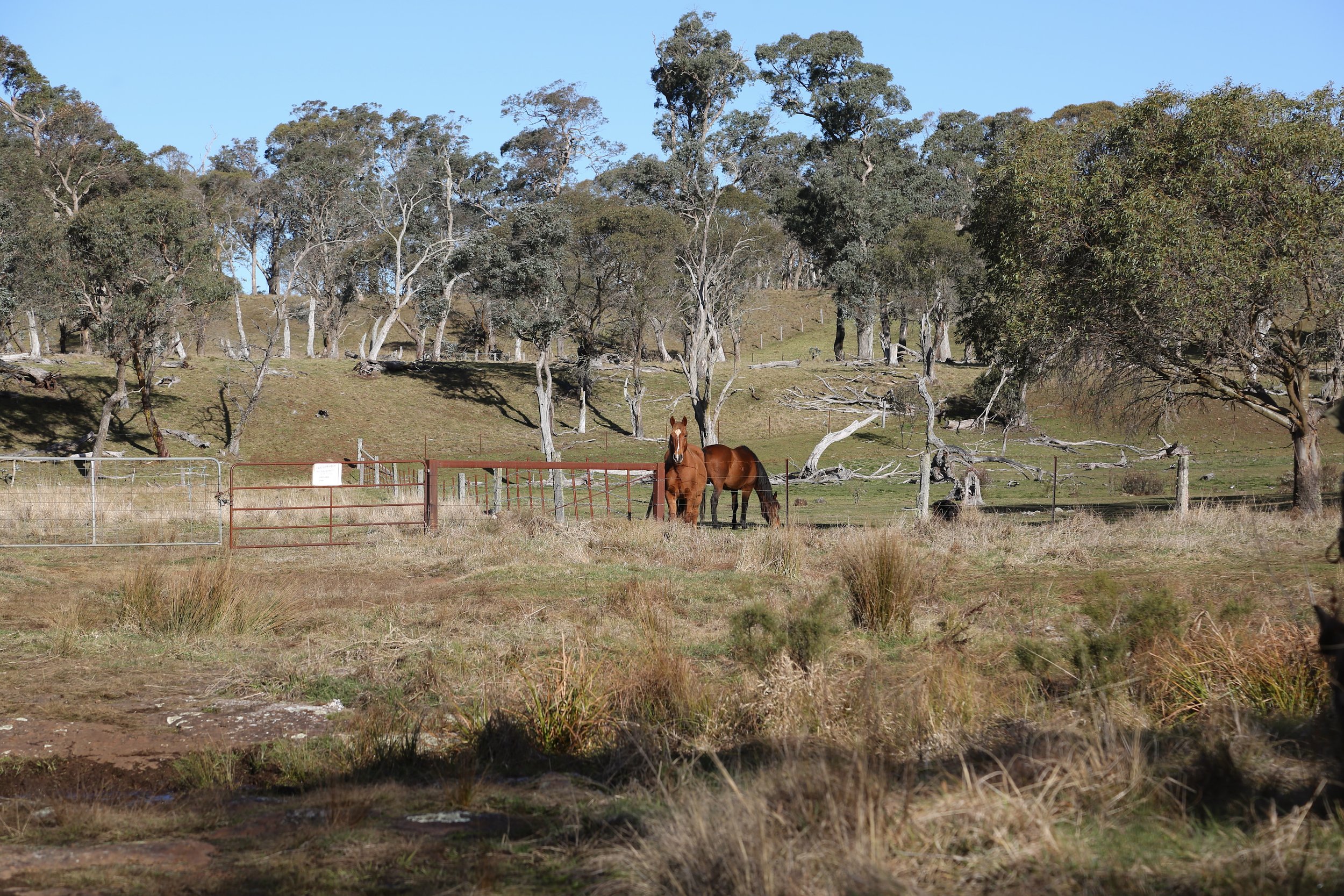
Horses in Ebor, NSW close to the Guy Fawkes Heritage Horses Holding Facility.
Why the Horses Are Managed, Not Left Entirely Wild
It's easy to see passive trapping and rehoming as being at odds with the idea of a truly "wild" brumby, but talking to the people who actually run the Association tells a more complicated and honest story. The volunteers at Guy Fawkes are firmly against aerial culling, but they're equally clear that some form of population management is necessary, since without it, horses have been found starving to death during poor seasons, all competing for the same limited feed in a landscape that can't support unlimited numbers. Their goal isn't to remove every horse from the park, it's to keep a healthy, sustainable population of wild Guy Fawkes horses running through the Guy Fawkes River National Park indefinitely, while giving surplus horses a real future instead of a cull.
Passive trapping had occurred fairly consistently since 2004, but paused for a prolonged period, several years by most accounts, before resuming again in 2026. That pause is part of why horses are only now becoming available again after a long gap, so if you've been waiting to get your hands on one of these horses, now is a genuinely good time to ask.
A Firsthand Look Behind the Scenes
I haven't been to a Guy Fawkes Open Day myself yet (though I'm hoping to make it to this one), but I did get a preview of what the Association's work actually looks like up close during a pack saddling clinic with Kate Young, where I met her counterpart Graeme Baldwin, a co-founder of the Association. Graeme offered to take a few of us out to the holding facility to feed the horses, and it's stayed with me since.
It was a frosty morning, the paddocks were huge, and the horses were all still in their thick winter coats, watching us curiously as we arrived before some came trotting over for hay. It felt less like visiting a facility and more like stepping into a fairytale, quiet, still, and completely removed from everything else. Graeme mentioned he'd recently bought a brumby for his granddaughter, and when I asked him what these horses meant to him personally, he couldn't answer, he got too emotional and had to walk away for a moment. He didn't need to finish the sentence. Graeme and Kate are the ones who handle and lightly train the newly trapped horses before they're ready to be rehomed, and it clearly isn't just a job to either of them.
That's genuinely what the Open Day offers anyone who attends: a chance to see this same holding facility, meet the people behind it, and understand exactly why this Association has kept going, entirely on volunteer time, for over two decades.
Have you been to a Guy Fawkes Open Day before, or has one of these horses found its way into your life? I'd love to hear about it in the comments.
Guy Fawkes Heritage Horse or Brumby? What's the Difference?
You'll often hear these horses called brumbies, and technically that's fair, they do run wild. But the Association itself is careful to describe them as Heritage Horses first, since that name reflects something most brumby populations in Australia don't have: formally documented, government-recognised proof of their specific military and historical bloodline. Not every brumby in Australia can claim that, which is part of why the Guy Fawkes horse has built such a dedicated following, and such a long waitlist of people wanting one.
It's also worth noting these are a different population entirely from other Australian brumby programs, including The Brumby Project's 10-Day Starting Camps, which work with brumbies from different regions altogether. Each brumby population around Australia has its own distinct history and story, and the Guy Fawkes horse's link to the Waler and to Beersheba is genuinely unique to this particular park.
Is the Guy Fawkes Heritage Horse Open Day Worth Attending?
If you have any interest in Australian wild horses, military history, or simply want to spend a day somewhere genuinely peaceful in the New England Tablelands, yes. This isn't a polished commercial event, it's a small, volunteer-run day that exists purely to keep an important piece of Australian heritage alive, and that comes through in everything about it.
Considering getting your own brumby one day? Events like this, and clinics like the pack saddling one I attended, are a genuinely good way to start learning before you commit. Tell us in the comments if you're thinking about it, I'd love to compare notes.
Frequently Asked Questions
-
The 2026 Open Day is scheduled for Sunday 11 October, at the Association's holding facility near Ebor, NSW. The full program hadn't been confirmed at time of writing, so it's worth checking the Association's website closer to the date.
-
They're wild horses living in Guy Fawkes River National Park, NSW, and are the only Australian wild horse population with formally proven military and historical heritage value, as direct descendants of the Waler cavalry horse used by Australia's Light Horse Brigade in the First World War.
-
Yes. The Association passively traps horses removed from the park under an NSW National Parks and Wildlife Service program and rehomes them to the public. Trapping paused for a prolonged period, several years by most accounts, and only resumed again in 2026, so horses are currently available after a long gap. Demand has historically outstripped supply, so it's worth getting in touch with the Association directly for current availability.
-
No. Aerial culling hasn't been used in Guy Fawkes River National Park since 2000, when over 600 horses were killed there, prompting national outrage and a government-commissioned heritage study. Since 2004, the Association has managed population numbers in this park through passive trapping and rehoming instead. It's worth noting that aerial culling has been used more recently in other NSW parks, most notably Kosciuszko National Park, where it remains a highly contested and separate issue, but that program is unrelated to Guy Fawkes River National Park or the GFHHA.
-
No, Open Days are open to the general public. Associate Membership is available for $10 a year if you'd like to support the Association's ongoing work.
-
Not exactly. While they're often informally called brumbies, the Association prefers "Heritage Horse," since this population has a specific, documented historical bloodline that most brumby populations don't. Different brumby populations around Australia, including those managed by other organisations, have entirely separate histories and origins.