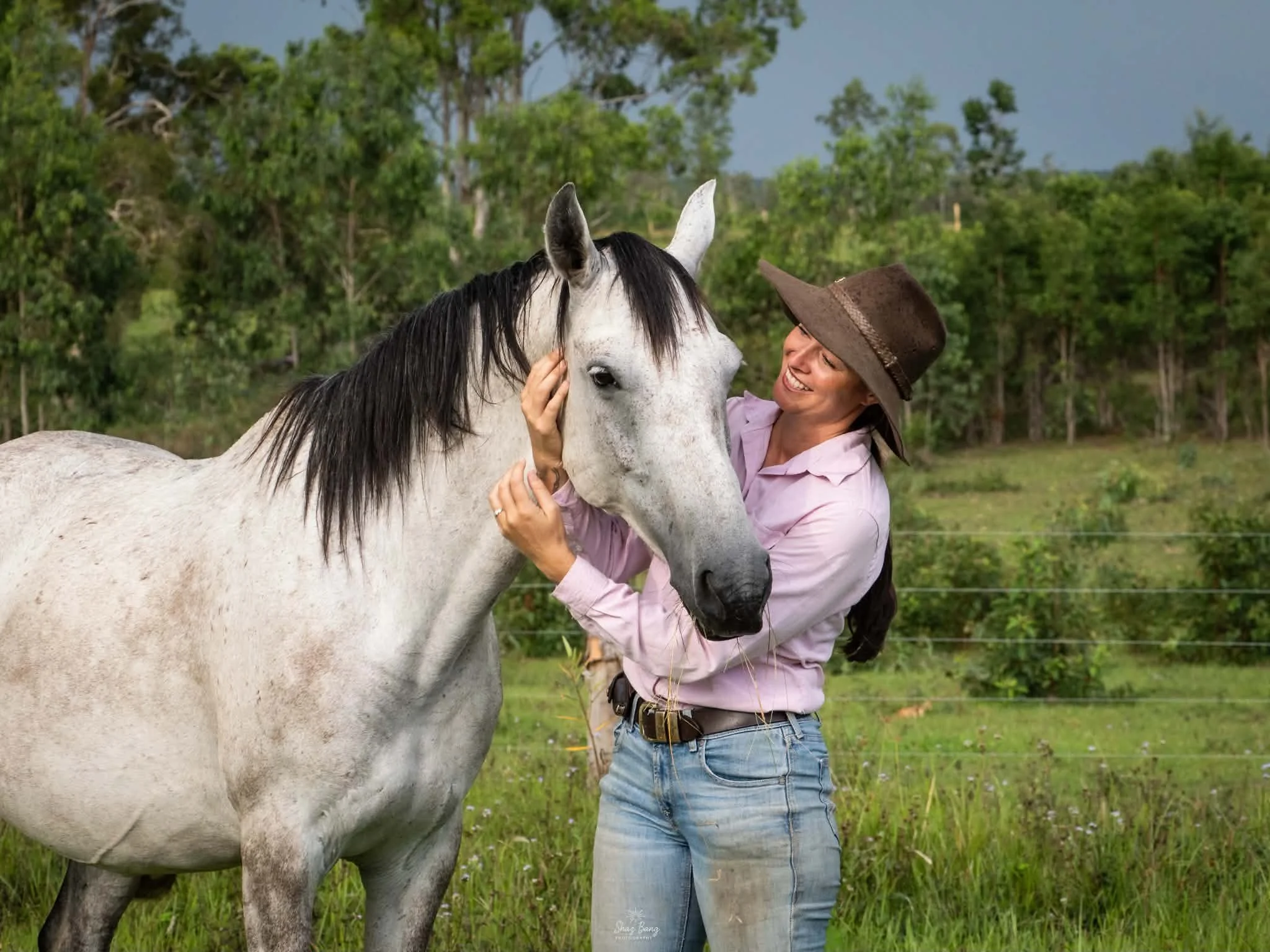
Horse trainer Holly Van Slooten with a horse in the bush
Holly van Slooten has built her life around wild horses, wide country, and the kind of quiet transformation that only happens when you stop trying to be in charge.
There are people who come to horses later in life, drawn by a specific moment or a specific animal, and there are people who cannot remember a time before them. Holly van Slooten is the second kind.
Ask her where it started and she laughs, because the question assumes there was a beginning.
"I just knew from my very first memories that horses were it for me," she says. "You could say I came out the womb saying 'giddy up' and 'yeehaw.'“
It is said with the easy humour of someone who has stopped trying to explain something that feels as fundamental as breathing. But the life that followed is anything but casual. Today, Holly lives on a hundred-acre property in Wolvi, near Gympie in Queensland, where horses are not a feature of the landscape so much as the reason for it. She shares the land with her husband Kyle, twenty-one horses, six dogs, three sheep, four cats, and a flock of poultry. Every day begins and ends with horses. She rides most mornings, works young horses several days a week, and spends the rest of her time teaching others how to read and be read by the animals they share their lives with.
Born and raised on the Sunshine Coast, with Dutch and Māori heritage woven through her, Holly describes herself simply as an Aussie girl living out her country dreams. What those dreams look like in practice is something harder to summarise: horsewoman, trainer, teacher, brumby advocate, and now the person behind Healing Horses, a free program that invites people struggling with depression onto her property to spend time with her herd. Not as a structured therapy. Not as a lesson. Simply as an experience of being near animals that respond to what you carry inside you, whether you want them to or not.
The Mare That Started Everything
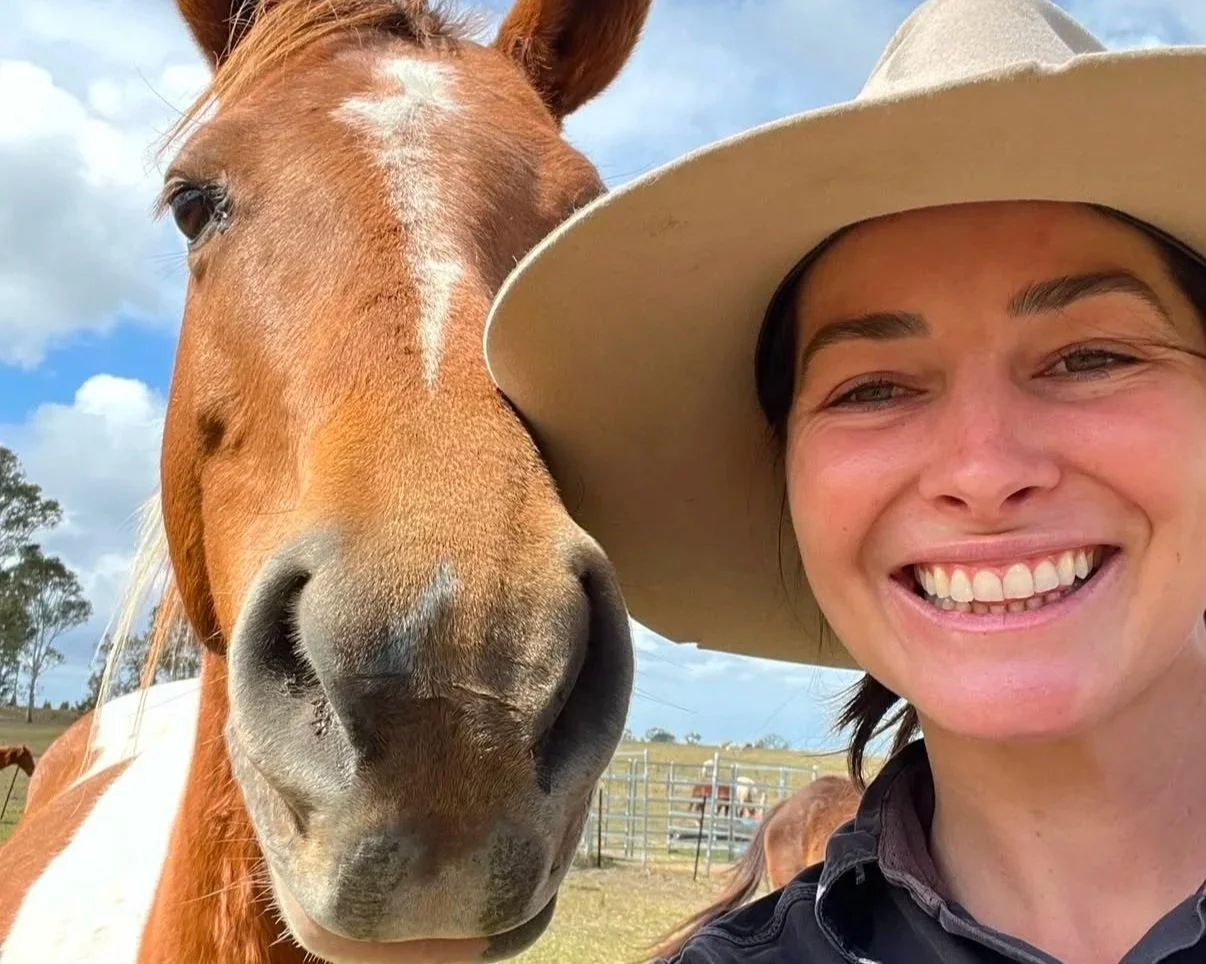
The mare that started it all, Hazel.
When Holly went looking for her first horse in her early twenties, she was after something trained and rideable. What she came home with instead was a traumatised, emaciated broodmare with a three-month-old filly at her hip, and absolutely no plan for what came next.
The mare was Hazel. The foal was Bambi. And Holly, by her own account, had no idea what she was doing.
"I was looking for one horse and somehow came home with two," she says, laughing at the memory. "I fell in love with a horse that had no reason to trust anyone, and I had no skills to offer her yet."
What followed was less a training journey than a mutual negotiation. Hazel arrived carrying the full weight of whatever had happened to her before, and rebuilding that trust required Holly to become a different kind of person than she had been. More patient. More consistent. More honest about what she was bringing to the yard each morning, because Hazel would tell her anyway.
"I am thankful to Hazel for everything she taught me," Holly says. "Not only for helping me become the horsewoman I am today, but also the person she helped me grow into."
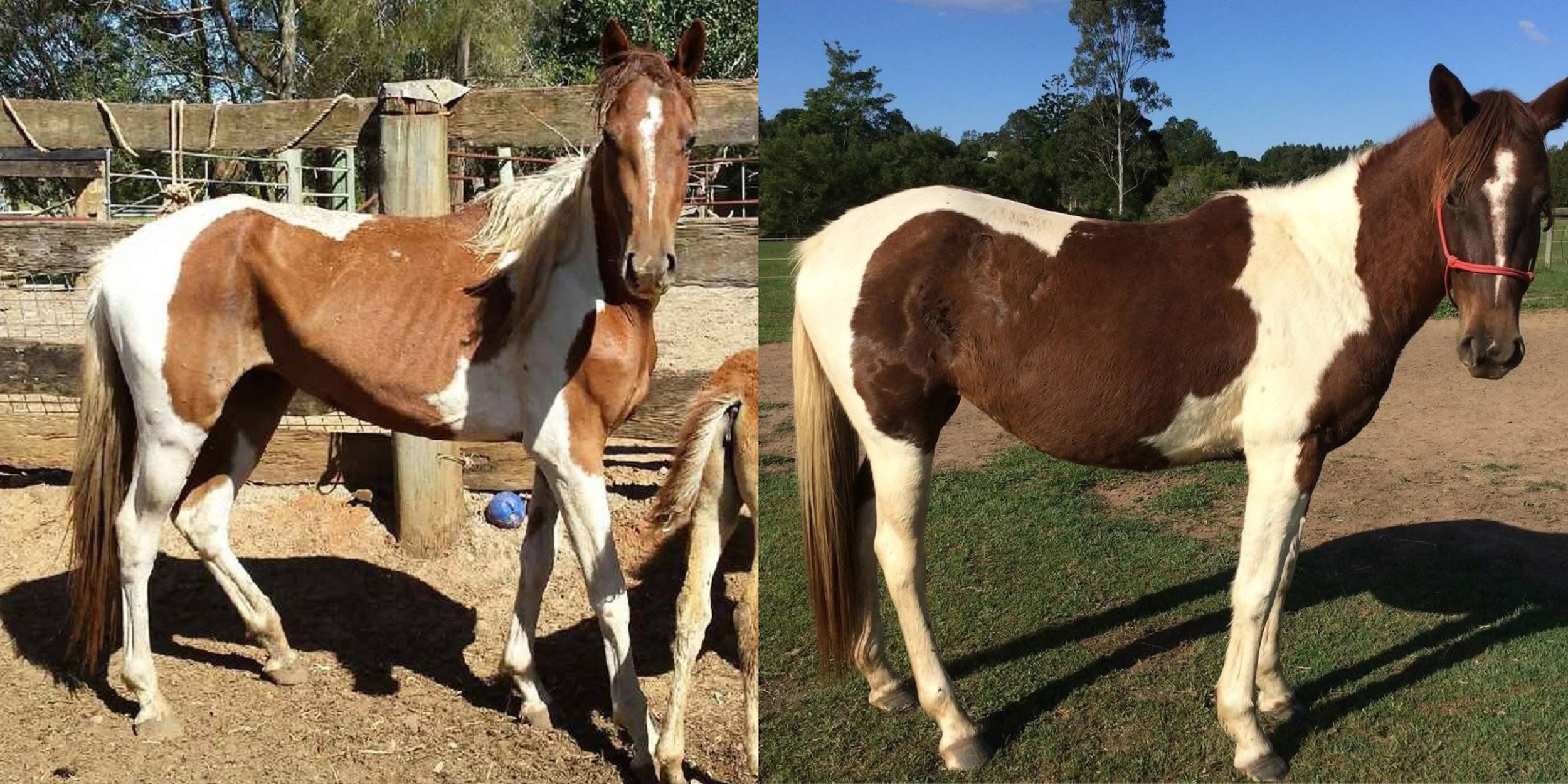
Hazel before and after.
Born of Bush and Story
“My ‘Pop’, he would tell me stories of how he would catch brumbies, train them up and sell them to the army for 20cents a horse when he was a young fella”
Long before Holly ever trained a horse, horses were already part of the stories her family told. Her grandfather would describe catching brumbies as a young man and selling them to the army for twenty cents a head, a detail that still sits strangely in the imagination, part history, part folklore, part reminder of how differently this country once used the wild horses that moved through it.
Those stories planted something. So did The Silver Brumby, The Man from Snowy River, the world of McLeod's Daughters. For many Australian children, these were entertainment. For Holly, they felt like confirmation of something she already knew.
Her first real encounter with brumbies came through Anna, an old school friend she had lost touch with for years, who invited her to a brumby camp in 2017. Anna is the founder of The Brumby Project, and that camp changed the direction of Holly's life with horses entirely."
"I fell madly in love," she says, without qualification.
She spent the following years attending every camp she could, taking spare brumbies home to train and rehome. When her own business grew and the camps became harder to fit in, she drifted away for a time. Earlier this year, Anna called to ask if she would travel to New South Wales to work as a trainer at a March camp, and Holly said yes without hesitation. She is now a trainer with The Brumby Project, guiding participants through the ten-day process of gentling a wild horse while ensuring the learning stays hands-on, real, and theirs.
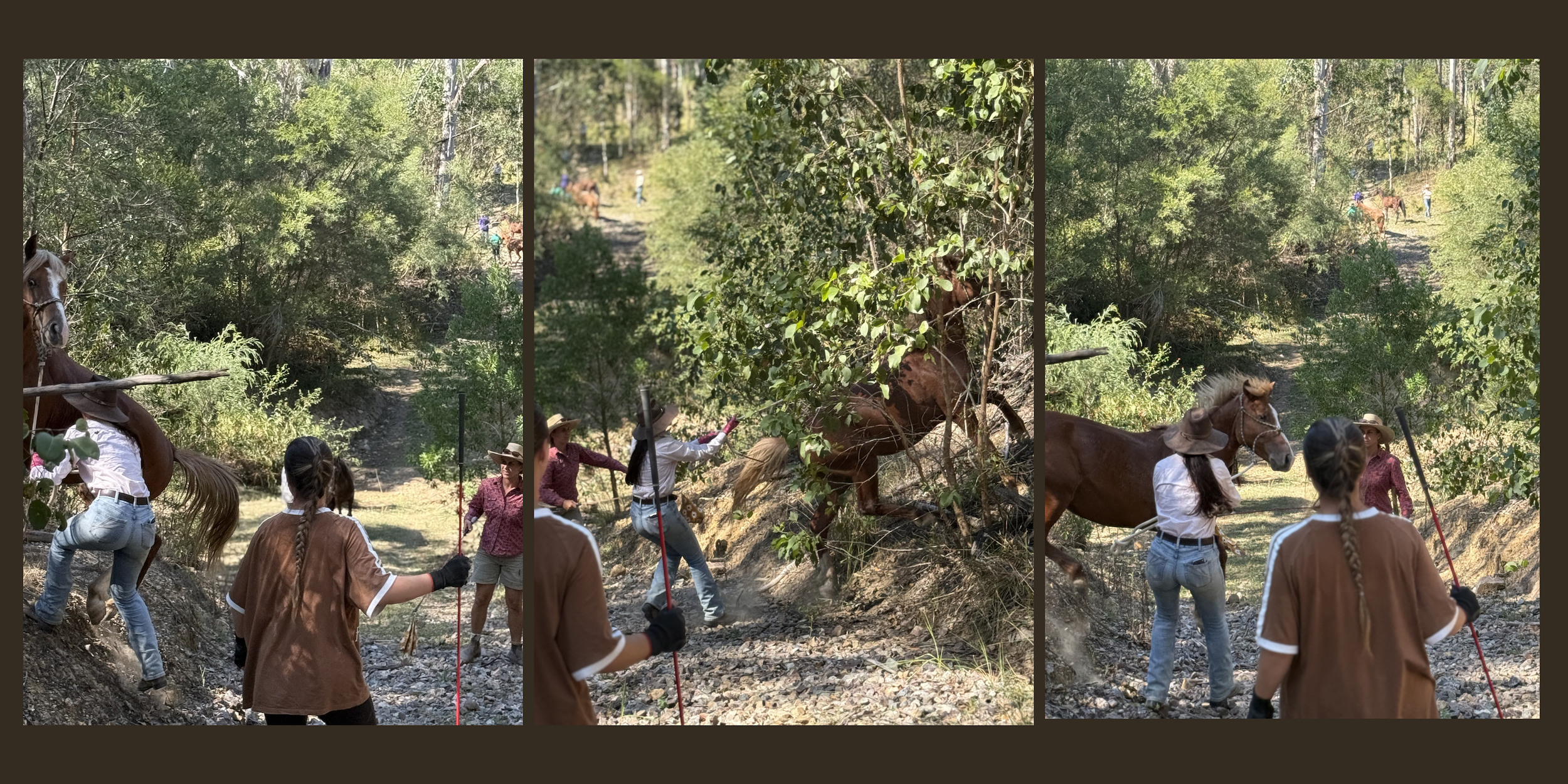
Holly wrangling a brumby during brumby camp
The Clean Slate
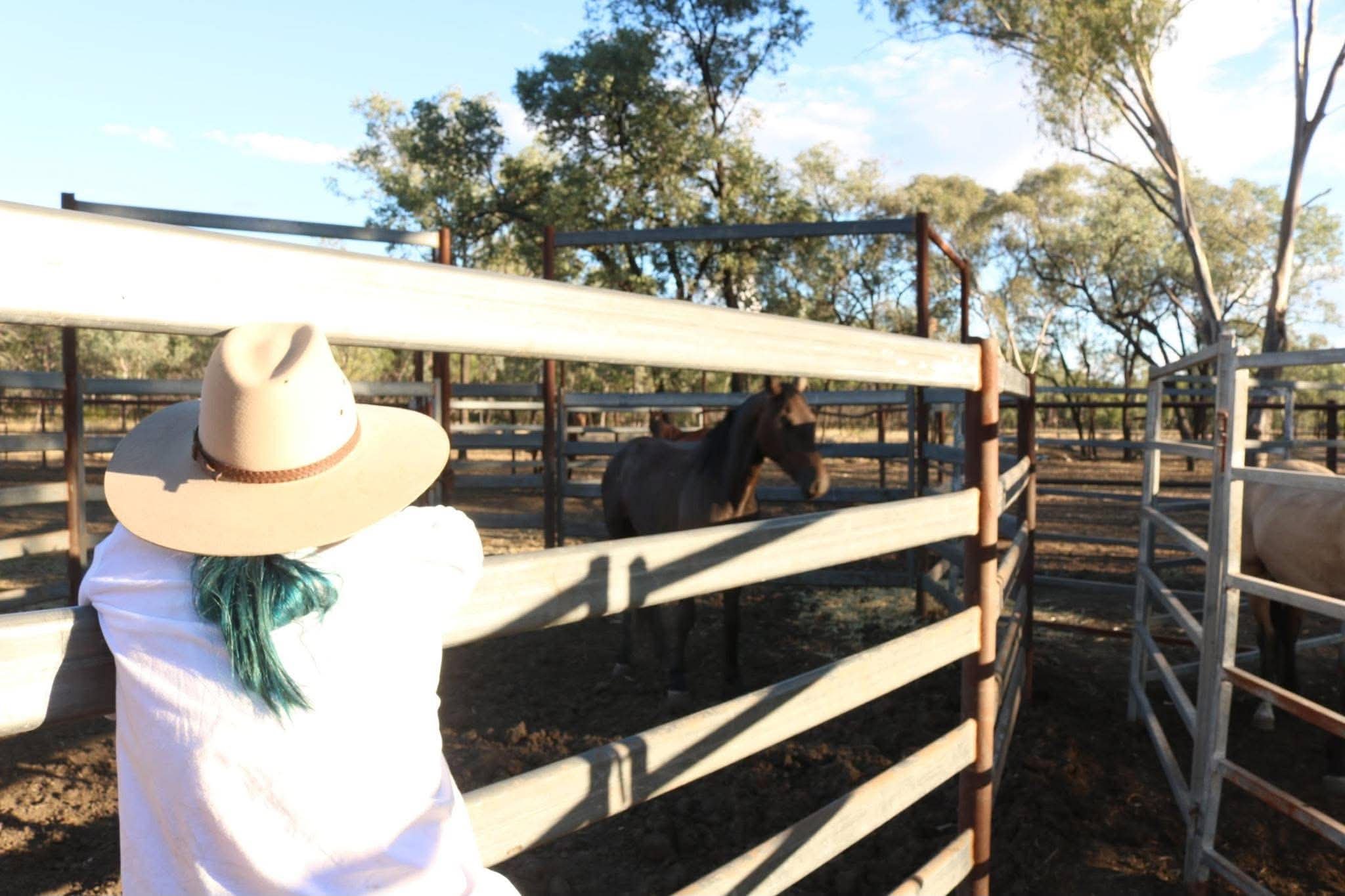
What fascinates Holly most about brumbies is not their wildness, though the wildness is real. It is their openness to connection despite having every reason to refuse it.
A brumby has never been shaped by human expectation. It has never been pushed past its comfort in a round yard by someone wanting results on a deadline. It has no history of rough handling, no learned avoidance, no scar tissue from training methods that prioritised obedience over understanding. It arrives, as Holly puts it, as a cleaner slate than most domestic horses, not because it is simpler, but because it has not yet been complicated by us.
"They are the most pure form of horse, in my eyes," she says. "Wild, never before touched by human hands, not spoiled by our expectations and selfish wants yet. They have absolutely no reason to trust us and no need to have a relationship with us, yet somehow we can build one through body language alone."
That communication, she says, never stops being extraordinary to witness. A prey animal and a predator, negotiating trust across a language made almost entirely of posture, breath and movement. She has done it dozens of times and it still stops her.
What she has noticed, though, is that the brumby has a fairly reliable way of separating the people who are ready for that conversation from those who are not.
"I think there are two types of people drawn to brumbies…" she says.
"Those seeking genuine partnership, growth, humbleness. And those driven by ego, out to prove something, full of expectations. The brumby requires you to be a complete beginner and surrender to the learning process. The second type always struggles the most."
It is not said unkindly. It is said as observation, the kind that comes from watching the same thing play out enough times to understand the pattern.
What Horses Reveal
Holly talks about horses the way some people talk about long friendships: with the particular respect that comes from having been seen clearly by something you cannot fool.
"Horses show you who you really are," she says. "No hiding, no ego, just bare, honest truth."
She has watched horses reveal the worst in people. She has watched them reveal something much better, the capacity for accountability, for patience, for the kind of humility that is not weakness but accuracy about where you actually are. She has come to believe that most people, when they first work with horses, are not ready for the level of self-honesty the animal requires. The horse does not care about your story, your credentials, your intentions. It responds to what you are actually doing, right now, with your body and your energy.
"Working with horses requires you to be continually learning, willing to adjust, willing to take accountability for your emotions," she says. "Your ego serves you nothing with these animals."
The discipline required, she is quick to add, is not only the horse's demand. It is her own ongoing challenge.
"Staying consistent is my biggest challenge," she says. "Motivation is not consistent and horses need consistency. When I am disciplined, the self-doubt disappears because I can see the results. When I am not, things fall apart."
She pauses. "I hope that makes sense."
It makes perfect sense.
Camp Fire and Country
There is a version of Holly's life that is best understood not through her achievements but through her sensory memory of it. The smell of a camp fire and eucalyptus. The sound of horses chewing hay in the dark. The early morning chorus of birds, followed by the soft nicker of a horse telling her it is time for breakfast. Kangaroos moving through the paddock in the low light.
A place in central Queensland called Black Springs holds particular meaning for her, the place where she worked with her first brumby, Kinder. Remote, cut off from the ordinary rhythms of town life, where mornings began with wild horses visible on the horizon and the day was shaped by fire, work, and silence.
"Pure magic," she says, and there is nothing performative in it.
Her idea of a perfect day is not a clinic breakthrough or a competition ribbon. It is sitting in the paddock while her horses graze around her, watching them play and kick their heels up, listening to them eat.
"Nothing better," she says.
Freedom, for Holly, is similarly specific. A solo ride through the bush. A horse that chooses to come to her in the paddock, stepping away from good grass to share company that was not demanded. The feeling of a gallop on open ground, when the country opens up ahead of you and there is no outcome to manage, just movement.
"That feeling goes deep in your soul," she says. "Only people who have experienced it really understand what I mean."
What She Has Lived Through
Holly speaks openly about the years before horses became the centre of her life, because she believes the contrast matters for people who might be sitting in the same darkness she once was.
From a young age she battled depression. Traumatic experiences she did not have the tools to process at the time drove her toward alcohol and drugs in her early twenties, and she describes the period with the kind of straightforwardness that only comes from having come out the other side.
"I was portraying the fun-time party girl," she says. "But at the end of most nights, I was heavily considering ending it all."
She tried, on more than one occasion.
Kyle came into her life at nearly her worst point and, by her account, simply accepted her in all her forms. When he noticed the way she lit up watching horses in paddocks on the side of the road and mentioned the stories she told about riding as a child, he took her on a horse riding date. She describes it as the moment her childhood passion came back, quietly and without fanfare, like something that had been waiting.
Six months later, he bought her Hazel and Bambi.
The shift was not dramatic or sudden. She is careful about that. The horses gave her a reason to get out of bed. They required her presence, her consistency, her clear head. The more time she spent with them, the less time there was for anything else, and slowly anything else began to lose its hold.
"The shift with horses saving me wasn't overnight," she says. "It was slow and steady."
She has not touched alcohol or drugs since July 2025. She is, as she puts it, doing the best she has ever been.
Her faith is part of this story too, and she does not separate it from the horses or from Kyle or from the slow work of becoming someone she recognises.
"God created the horses," she says. "He then put me in a position to have them, which helped turn my life around. Everything is divine timing."
She knows not everyone will receive that framing the same way, and she is at peace with that. She held this belief as a small child, talking to God daily, feeling something she describes as his love wanting to burst out of her onto other people. She lost her way from it for years. Coming back was not dramatic either, just a recognition of something that had been true the whole time.
Healing Horses
Because horses helped her so profoundly, and because she has so many of them, the logic of Healing Horses felt almost self-evident to Holly.
The program is free. There is no structured session, no therapeutic framework imposed on the experience. People who are struggling with depression come to the property and spend time with the herd. The horses do what horses do: they respond honestly to what they sense in the person beside them, and that honesty, over time, tends to open something.
"I am living proof that you can take your life back," Holly says. "I thought if horses helped me so much, why not share them with others who are struggling?"
She does not overstate what it can do. But she has lived what it did for her, and that is enough to offer it without qualification.
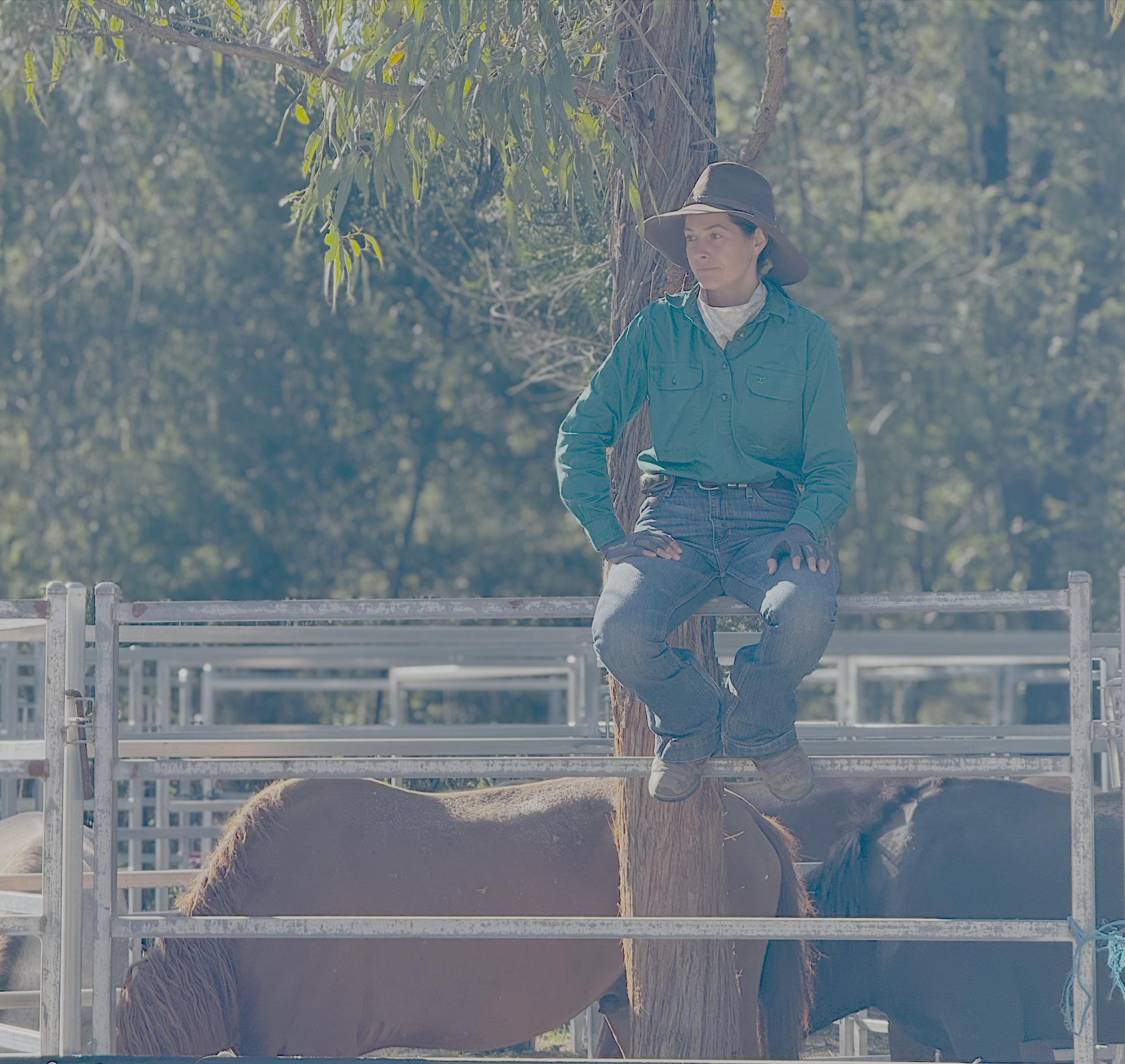
Holly Training participants at The Brumby Project 10 day brumby camp
The Industry She Wishes Were Kinder
Holly did not enter the horse industry expecting competition. She entered it the way she entered everything to do with horses: with uncomplicated enthusiasm and the assumption that everyone else felt the same.
She found out quickly that was not always the case.
"I was like a little kid, excited to play with all the pretty ponies and thinking I was doing it with friends," she says. "Then I started my own business and suddenly people I thought were friends were trying to compete with me, tear me down behind my back."
She has encountered jealousy, betrayal, people working against rather than alongside. She has also thought carefully about what drives it.
"If you have a good business, what are you worried about?" she says. "There are more than enough clients to go around. If you have time to worry about other businesses, redirect that energy into your own."
What she wants, and what she tries to model, is something more straightforward: horse people supporting each other, genuinely celebrating each other's work, sharing knowledge rather than hoarding it.
"Not one trainer has all the answers in horses," she says. "If we worked together rather than against each other, the horse world would be a much better place."
She also has clear views on what the broader culture still needs to reckon with, namely, the bucking and bravado mentality that treats roughness as a virtue and compassion as weakness. That, she says, needs more reflection and considerably more empathy before it earns the title of horsemanship.
The Life She Chose
From her property in Wolvi, Holly offers lessons, young horse starting camps, brumby handling, problem-solving sessions for horse and human, trail rides, and online coaching. She hosts other clinicians too, because she believes the industry is better when knowledge moves around freely between people who care about getting it right.
The horse she would most recommend everyone experience working with is a brumby. The piece of gear she cannot live without is a good pair of leather split reins. Her dream adventure is a trek through the high country. The Australian horse event she loves watching is campdrafting.
Her advice to anyone approaching a brumby for the first time: go in with an open mind, no expectations, and a genuine willingness to be a student of the horse, not just once, but for the rest of your life.
Her hope for the future of Australian bush horse culture is that it continues for generations, that the methods keep evolving, and that compassion and horse welfare stay at the centre of it all.
She hopes the brumby never disappears. They are, she says, a massive part of Australian heritage, and there are forces working hard to eradicate them. That concerns her deeply, for the horses and for what it would mean to lose something so elemental from the Australian landscape.
At the end of all of it, the clinics and the camps, the early mornings and the problem horses and the people who need fixing as much as their animals do, what Holly returns to most naturally is not an achievement or a milestone.
It is the image of her horses in the paddock, moving freely, choosing to come to her.
A prey animal and a predator. Trust built over years of showing up honestly, without shortcuts, without ego, without demanding more than was being offered.
That, she says, is the whole thing.
That is what all of it is for.
Holly van Slooten is based in Wolvi, Queensland, near Gympie. She offers horsemanship lessons, young horse starting clinics, brumby handling experiences, trail rides, and the free Healing Horses program for people experiencing depression. She is also a trainer with The Brumby Project.
