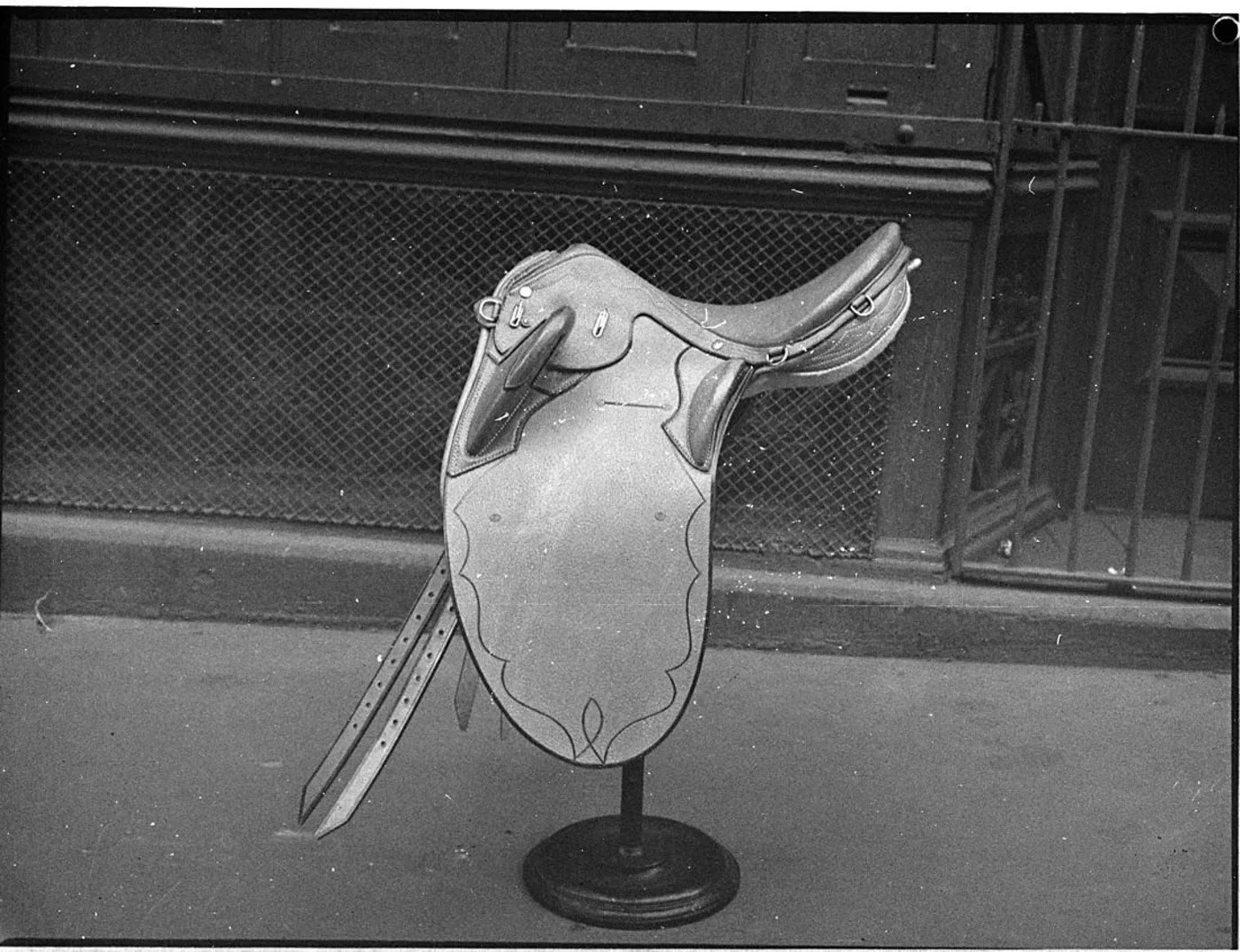
1936 Grace Bros., Sydney stock saddle. Source: Australian Stock Saddle History Facebook Page
An English saddle, reshaped by a rugged continent into something the rest of the world had never seen before, and a personal reflection on why so many of us don't ride in one anymore.
When I was younger, riding racehorses coming back into work, we'd sometimes reach for a stock saddle instead of our usual gear, generally when a horse was still a bit green and we wanted extra security. I remember exactly how it felt: genuinely comfortable to sit in, deep and supportive, the kind of saddle that made you feel like nothing was going to unseat you no matter what the horse did underneath you. When I came back to horses years later, I noticed something odd: hardly anyone seemed to ride in a traditional stock saddle anymore. Everyone had moved on to something with a swinging fender instead. I didn't know why, and it nagged at me enough that I went looking for the answer.
What I found was a genuinely fascinating piece of Australian history, one that answers a question I'd never thought to ask before: is the stock saddle actually unique to Australia, or did we just borrow someone else's idea?
Where the Stock Saddle Actually Came From
The honest answer is both. The Australian stock saddle wasn't invented from nothing, it evolved from the English park and dressage saddle, brought here by British settlers from 1788 onward. That original English saddle was built for polo fields and fox hunts across tame countryside, flat, with small knee rolls and short flaps. It was never going to survive contact with the Australian bush.
Settlers and saddlers quickly found the English design fell apart under real Australian conditions, long days in the saddle, rough terrain, buckjumping horses, and cattle work across vast, unfenced stations. So they started changing it, bit by bit, until what emerged was something genuinely new: deeper in the seat, higher in the cantle, and fitted with a feature that didn't exist anywhere else in the world.
The Poley: The Feature That Makes It Australian
That feature is the poley, the flared, padded knee block at the front of the saddle. It's the single defining characteristic that separates an Australian stock saddle from anything else on earth, English, Western, or otherwise. The name itself has a slightly odd origin: a "poley" is an old term for a hornless cow, and the earliest kneepad shapes apparently resembled that animal's ears closely enough that the name stuck.
The poley wasn't just decorative. It gave stockmen genuine security, if a horse stopped suddenly, spooked, or bucked, the rider's thigh locked in behind the pad rather than being thrown forward. Over the decades the poley crept higher, from the knee up toward the thigh, as saddlers refined exactly where the extra support was actually needed.
Just as deliberate was what the Australian stock saddle chose to leave out: a horn. Western saddles, descended from Mexican and American vaquero traditions, kept the horn because cattle were worked by roping and throwing them. Australian stock work developed differently, cattle were worked by campdrafting them through yards and paddocks rather than roped, so a horn simply wasn't functionally necessary in the first place. It also would have been a genuine liability, catching on thick scrub while mustering cattle through dense bush, so saddlers had good reason to leave it off entirely rather than just no reason to add it.
The other defining innovation is the safety stirrup bar, a curved steel hook that the stirrup leather sits on. In a fall, or if a rider's boot gets dragged, the leather can slip free of the bar rather than trapping the rider. If a stirrup catches on a stump or fence post while the horse is moving, the bar itself bends outward, releasing the leather before anyone gets seriously hurt. It's a quietly brilliant piece of design, built entirely around the specific dangers of working on horseback in rough Australian country, and it remains standard on stock saddles to this day.
The Saddlers Who Actually Built It
The stock saddle wasn't the invention of one person, it was shaped by dozens of working saddlers across the country, most of whose names have faded from memory outside a handful of dedicated historians and collectors.
John Jones is the earliest documented figure, advertising "Stock and Bush saddles" in 1833, featuring soft stuffed rolls sewn onto the flap for leg protection, one of the first steps away from the plain English design. Three decades later, William Mitchell Jnr, working out of Wagga Wagga, developed what became known as the "Wagga saddle" around 1863 to 1865, raising the knee pad higher and shortening the traditional "frying pan" seat. It became so popular that stockmen reportedly bypassed established Melbourne saddlers entirely just to get one made by Mitchell himself.
Jack Wieneke made his name in 1898 after riding a notoriously difficult horse to a standstill in a saddle of his own design, later called the Outlaws Master, featuring dramatically large knee and thigh pads. His designs stayed popular for years before eventually being seen as too extreme, and the market settled back toward more conservative styles.
One name deserves particular attention: Rose Harris, from Queensland, became Australia's first known female commercial saddler in 1918, in her early twenties, making saddles for soldiers of the Australian Light Horse, the same cavalry famous for the charge at Beersheba. It's a detail that connects the story of the stock saddle directly to the history of the Waler cavalry horse, another piece of Australian equine heritage built for exactly the same unforgiving conditions.
One story genuinely stands out, and I have Janice Gifford to thank for it. Janice once bought an Australian stock saddle from a man in Italy, who had originally brought it home from Afghanistan. Baffled as to how it got there, she checked the maker's name stamped into the leather, Robert Smith, typed his name and "Afghanistan" into Google on a hunch, and the connection came up almost immediately: Smith had made several saddles for the Amir of Afghanistan back in 1898, and this was one of them.
I actually got that story firsthand, from Janice herself, over the phone. The Australian Stock Saddle History website randomly popped up in a Facebook group I'm part of, and it caught my attention immediately, a whole site dedicated to the individual saddlers who built this industry, and I was so curious about when the museum would actually be opening that I found a number on their Facebook page and just rang it. Janice picked up, and what I expected to be a quick fact-check turned into one of the most genuinely enjoyable conversations I've had since starting The Bush Pony. She's a bubble of positive energy, clearly still thrilled by every saddle and every story after all these years, and she was just as excited that someone had called to ask.
Janice runs the historic Tenterfield Saddlery with her husband Tony, a working saddler, and has spent more than four years researching Australian stock saddle history, personally collecting over 135 stock saddles along the way, twelve of which now live at the saddlery itself. She's the principal researcher behind Wild Ride: The Story of the Australian Stock Saddle, written by Fiona Carruthers, but the published book only captured a condensed version of everything she'd actually found. That's exactly why she built the Australian Stock Saddle History website, sourced largely from Trove's archive of historical Australian newspapers, and why she's now working toward a proper museum to give the rest of that research, and the saddles themselves, a home the book never could, though she still needs more funding to make it happen.
The plan is to restore the historic Bernborough stables at Highfields Pioneer Village in Toowoomba, so this history finally has a permanent public home rather than staying scattered in private hands. I've stood outside the Tenterfield Saddlery myself before, always closed whenever I happened to be passing, and after that phone call, I can't wait to actually get inside. We'll have a full profile on Janice and the museum project coming soon, this is a woman and a mission genuinely worth knowing about.
About the Museum Project
The proposed Australian Stock Saddle Museum aims to restore the historic Bernborough stables at Highfields Pioneer Village, Toowoomba, QLD, as a permanent public home for Janice Gifford's collection of over 135 Australian stock saddles and decades of research. The project's GoFundMe campaign, run by Highfields Pioneer Village, Museum & Park Inc., has a goal of $220,000 (around $120,000 to restore the building, plus $100,000 to fit it out), with just over $5,000 raised so far.
Support the campaign: gofundme.com/f/australian-stock-saddle-museum | Follow updates via the Australian Stock Saddle History Facebook page | Learn more at australianstocksaddlehistory.com.au
So, Is It Genuinely Unique?
Yes, and the nuance is what makes it interesting. The Australian stock saddle isn't a completely original invention, it's an adaptation, built on an imported English foundation. But what Australian saddlers did with that foundation, the poley, the absent horn, the safety stirrup bar, the deep, supportive seat, doesn't exist in quite the same combination anywhere else in the world. It's often described as a genuine hybrid: the close leg contact of an English saddle, with the security of a Western one, purpose-built for a landscape that demanded both.
Have you ridden in a traditional stock saddle yourself? I'd love to hear what you thought of it in the comments.
So Why Don't More People Ride in One Anymore?
This is where my own question finally got answered. The traditional stock saddle, with its plain flap and narrow, fixed stirrup leather, had one genuine flaw: that leather could pinch the rider's leg uncomfortably over a long day's ride. Saddlers eventually solved this by borrowing a Western-style swinging fender, wider, independently moving, far more comfortable over long hours, while keeping the Australian tree, seat and poley underneath. The result is often called a "half-breed" saddle, and it's become the dominant style for trail riding, polocrosse and general pleasure riding today.
Interestingly, the traditional plain-flap poley hasn't disappeared everywhere, it's just become less common here at home, even as it's grown in popularity overseas. Since the late 1970s, and gaining real momentum through the 1980s and 90s, the Australian stock saddle found a genuine following in the US and UK, helped along by The Man From Snowy River putting Australian stock horse culture in front of an international audience. These days it's not unusual to find more traditional poleys in an American trail rider's tack shed than in an Australian one.
So the saddle you and I grew up riding in didn't vanish, it just got quietly upgraded for comfort, and found a whole new audience on the other side of the world in the process.
Frequently Asked Questions
-
Not entirely. It evolved from the English park and dressage saddle brought by British settlers from 1788, but was substantially redesigned in Australia to suit bush conditions, with features like the poley and safety stirrup bar that don't exist on the original English design.
-
The poley is the flared, padded knee block at the front of an Australian stock saddle, its single most defining feature. The name comes from an old term for a hornless cow, which the early kneepad shape was said to resemble.
-
Australian cattle work developed around campdrafting cattle through yards and paddocks rather than roping them, so a horn wasn't functionally necessary the way it was on American and Mexican-descended Western saddles. It also would have been a genuine liability, catching on thick scrub while mustering through the bush, giving saddlers good reason to leave it off entirely.
-
The traditional design's narrow, fixed stirrup leather could pinch the rider's leg over long rides. Modern "half-breed" saddles solve this with a wider, independently swinging fender while keeping the traditional Australian tree, seat and poley, making them the more popular choice today.
-
John Jones (advertising stock saddles from 1833), William Mitchell Jnr (the "Wagga saddle," c.1863-65), Jack Wieneke (the "Outlaws Master," 1898), and Rose Harris, Australia's first known female commercial saddler, who made saddles for the Australian Light Horse from 1918.
-
The Australian Stock Saddle History website, built on Janice Gifford's research, has compiled detailed profiles of individual historical saddlers sourced largely from Trove's newspaper archives. Janice is also working to raise funds for a public Australian Stock Saddle Museum at Highfields Pioneer Village, Toowoomba, check the "Australian Stock Saddle History" Facebook page for current updates.